Sensing Materials / Data Science
Gas Detection — Gaussian Process Models
CLIENT — Gas-detection materials start-up
Interpreting reaction-signature data from precisely doped reactive materials, using Gaussian process models and neural networks to find the doping levels that give the best detection accuracy.
The challenge
The client had developed reactive compounds for gas detection and collected substantial data from controlled gas reactions, but needed to interpret that data and build the analytics to act on it. Reaction curves had to be extracted from noisy signals, and reactivity 'signatures' understood across the dataset.
Our approach
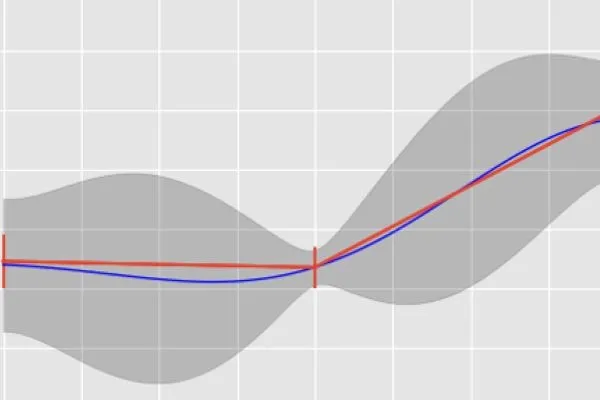
We reviewed and refactored the data-collection and analytics pipeline, then analysed gas-reaction readings against detector composition using Gaussian process models, extracting reaction-curve data from noisy signals with neural networks. We investigated reactivity signatures across the dataset and built predictive tools — combining signature analysis with the Gaussian models — to determine the optimal doping levels, delivered with processing code, user guides and documentation.
Results
We transferred the tools, techniques and understanding to the client's team, enabling them to advance their detection process independently.
Technologies
- Gaussian process models
- Neural networks
- Machine learning
- Specialist data analysis
- Bespoke development
Finding the doping levels that detect gas best — Gaussian process models over noisy reaction-signature data.